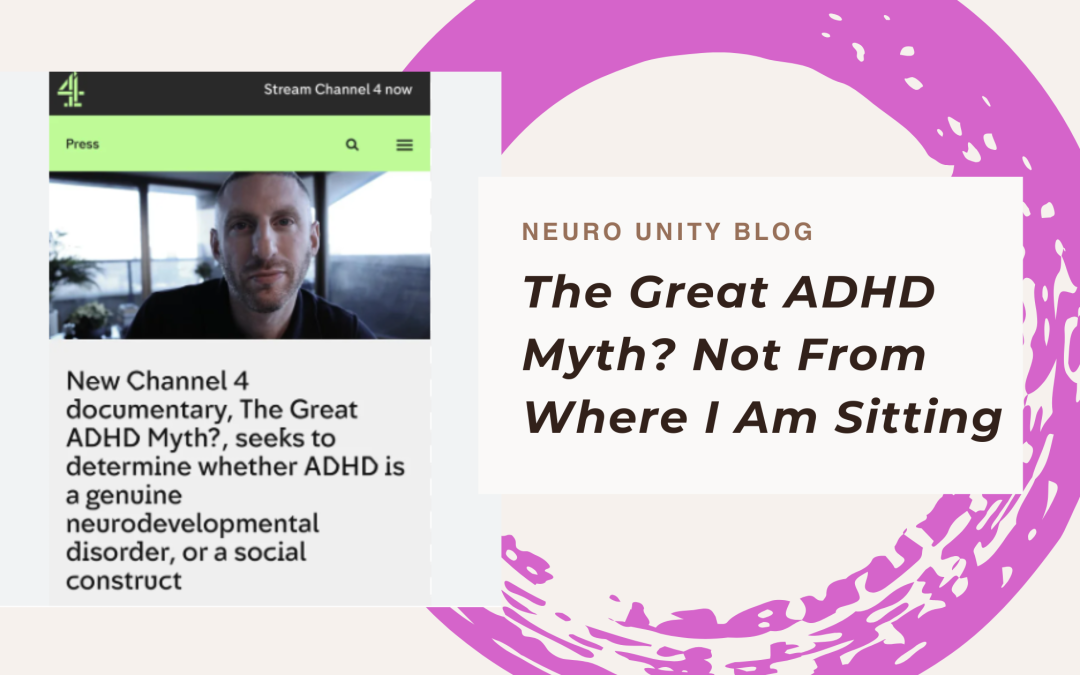
Last week Channel 4 announced a new documentary called “The Great ADHD Myth?”, fronted by NHS psychiatrist Dr Max Pemberton and due to air soon. The press release asks whether ADHD is “a genuine neurodevelopmental disorder, or a social construct” and whether we should really be “giving so many children powerful psychiatric drugs to medicate it”.
I read that press release three times. Then I sat with it for a while, because as the Founder of Neuro Unity and as someone who is #OpenlyNeurodivergent, diagnosed with autism in 2018 and with ADHD, dyspraxia and dyscalculia in January 2023, I know exactly what a programme with a title like that does to people like me. It does not stay on the television screen. It follows us into workplaces, into GP waiting rooms, into family group chats where a relative suddenly feels qualified to tell us our diagnosis is a trend. So I wanted to write this, in my own voice, using my own experience, and using the actual evidence, to push back.
What The Documentary Is Actually Claiming
According to Channel 4’s own press release, the film cites NHS data showing a 200 percent increase in the number of people referred for an ADHD assessment between 2020 and 2025. From that starting point it goes looking for reasons other than “ADHD is real” to explain the rise. It features Dr Iona Heath, former President of the Royal College of General Practitioners, saying “it is certainly not a medical condition as far as I’m concerned”, and Dr Sami Timimi, a consultant child and adolescent psychiatrist, saying “we’ve replaced corporal punishment with giving [children] a pill”. A family is followed as their son comes off medication in favour of sport, time outdoors and less screen time, to see whether that “cures” him.
I want to be fair. Channel 4 has said the documentary “does not deny the lived experience of people with ADHD traits” and that the experts featured have genuine NHS and academic backgrounds. That may well be true of the individuals involved. But the framing, right down to the word “myth” in the title, tells viewers what conclusion to reach before a single expert has spoken. And the reaction since the announcement, ranging from “irresponsible and dangerous” to “myth? It’s not a myth if you have ADHD”, shows I am far from the only one who has noticed.
The Evidence Does Not Support The “Myth” Framing
Here is what I know from the research, not from a feeling.
ADHD is recognised by NICE, the body that sets clinical guidance for the NHS, as a condition requiring proper specialist assessment and individualised, evidence-based treatment. That guidance, NG87, exists precisely because ADHD is treated as a genuine clinical condition within the NHS, not a lifestyle label.
In 2021, eighty scientists from twenty seven countries, convened by the World Federation of ADHD, published an International Consensus Statement in the journal Neuroscience and Biobehavioral Reviews setting out 208 evidence-based conclusions about ADHD, specifically to counter misconceptions like the ones this documentary seems built around. Twin studies referenced in that wider body of research put the heritability of ADHD at somewhere around 70 to 80 percent, which is in the same range as height. That is not proof of a “trend”. That is biology.
And the NHS’s own figures, the same body of data Channel 4 draws its “200 percent” headline from, estimate that around 2.5 million people in England have ADHD, including many without a formal diagnosis, and that referrals keep rising partly because awareness, screening and access have all improved. A rise in diagnosis is not automatically evidence of a manufactured condition. It can just as easily be evidence that people like me, who spent decades being told we were lazy, dramatic or simply “too much”, are finally being seen.
I would gently flag that I am not a scientist or a clinician, and I would encourage anyone reading this to look at the NICE guidance and the Consensus Statement themselves rather than take my word alone for it. But the weight of that evidence does not sit comfortably next to a title with a question mark stuck on the end of the word “myth”.
What This Looks Like From The Inside
I did not go looking for my diagnoses. My autism diagnosis came in 2018 when my GP asked me if I would take part in a study that Worcestershire Healthy Minds was running looking at undiagnosed autism in women between the ages of 40 and 45. My ADHD, dyspraxia and dyscalculia diagnoses came in January 2023, when I realised there was far more going on with me than just autism. If I had said no to taking part in that study, I still would not know today that I am neurodivergent. I had spent my whole life masking, covering up who I really was, putting sticking plasters over behaviour I had learned to be ashamed of – all so I could pass as neurotypical and therefore “normal”. When the ADHD diagnosis landed, finally, everything made sense. Not for the first time in my life, but for the first time with an explanation, not an excuse, attached.
I have written before on my blog Cyber Geek Girl about the comment that has stayed with me the longest, someone telling me “but you don’t look like you are neurodivergent”. I have spent hours looking in the mirror since, searching my own face for something that would prove them right or wrong. There is nothing to see on the outside. Inside it is a completely different story. That is exactly the problem with a documentary that treats ADHD as something you can settle by looking hard enough at outdoor activity levels, whether someone has a diet that is free from ultra-processed food and screen time. You cannot see a neurodevelopmental condition from the outside, and you certainly cannot resolve one in a few weeks of a television experiment.
I have seen this same disbelief before, and it left a mark. I have extreme heat sensitivity, something that is documented in autism research, not something I invented for attention. There is NO way on earth I would have spent over £7k to have an air conditioning system fitted at home just for attention. At secondary school my PE teacher forced me on a cross country run during a heatwave. By the time I got back I had collapsed, and when I asked for a drink of water, I was refused one by the teach and told I was “being dramatic” and “acting up” to get out of running. I could hardly breathe and my face had turned scarlet, but a genuine physiological response to the way my brain and body are wired was treated as me just acting up and being difficult. That is exactly the trap a documentary like this one sets. Tell someone often enough that something real about them is exaggeration or a modern excuse, and they start to believe it themselves, and that does far more damage than any diagnosis ever could.
I also spent most of my life until I was diagnosed being told, in one way or another, that if I just tried harder, behaved differently or fitted in better, everything would be fine. I masked, people pleased and reshaped myself for others for decades, and it left me with complex PTSD from a lifetime of bullying and abuse, and at one of my lowest points, in August 2021, suicidal. What actually changed things for me was not a lifestyle overhaul designed by someone else to make me easier to manage. It was getting the right diagnoses, working with a good therapist, and finally being who I am rather than who other people wanted me to be. It cost me dear, as due to no longer being the people pleaser I had been all my life and setting healthy boundaries, some family members who should have accepted me and loved me unconditionally decided they would no longer talk to me. Those same family members subjected me to vast amounts of bullying and abuse and were only happy when I was masking to be what they wanted me to be. I often wonder now whether it was sensing that I was neurodivergent that made certain people in my life treat me the way they did. A documentary that treats ADHD as something to be trained out of a child with more sport and fresh air sits far too close to that same old message, that the problem is the person, not the lack of understanding around them.
I have also written about the imposter syndrome that runs alongside my neurodivergence, the voice that tells me everything I have achieved must be a mistake and I will be found out at any moment. That voice gets louder every time a mainstream broadcaster puts a question mark next to my diagnosis and calls it entertainment. It tells people like me that we are not just difficult, we might be making it up.
Why This Matters Beyond One Programme
I am not against scrutiny of how ADHD is diagnosed, treated or medicated. Good, honest journalism should ask hard questions about waiting lists, about the pressure on the NHS and about whether every child and adult prescribed medication has had a genuinely thorough assessment. Those are fair and useful conversations. But there is a world of difference between asking “is our system for supporting ADHD good enough” and asking “is ADHD even real”. The first is responsible. The second, dressed up as investigative curiosity, is the kind of framing and clickbait that gets repeated in school corridors and HR meetings for years afterwards by people who never watched the documentary itself, only the headline.
So here is what I am asking of anyone reading this on Neuro Unity. Watch the documentary with a critical eye if you choose to watch it at all. Do not let one programme, however polished, undo the years of work so many of us have put into raising awareness of being neurodivergent through our lived experience And if you are autistic, have ADHD, or both, like me, know that your diagnosis is not a myth, a fashion or a modern construct. It is the reason so many of us finally understand ourselves, and it deserves to be treated with respect and more care than a provocative title on a press release.
Lisa Ventura MBE FCIIS
Founder, Neuro Unity
Proudly #OpenlyNeurodivergent
Sources
- New Channel 4 Documentary, The Great ADHD Myth?, Seeks To Determine Whether ADHD Is A Genuine Neurodevelopmental Disorder, Or A Social Construct – Channel 4 Press
- Channel 4 Slammed As Fans Fume New ADHD Documentary Sends ‘Dangerous’ Message – Mirror, via AOL
- Attention Deficit Hyperactivity Disorder: Diagnosis And Management (NG87) – NICE
- The World Federation Of ADHD International Consensus Statement: 208 Evidence Based Conclusions About The Disorder – Neuroscience & Biobehavioral Reviews, ScienceDirect
- Attention Deficit Hyperactivity Disorder In Adulthood And The Heritability Of This Condition – NCBI
- A Picture Paints A Thousand Words: Do I Look Neurodivergent? – Cyber Geek Girl
- Oh Yes…I’m The Great Imposter: Imposter Syndrome And Being #OpenlyNeurodivergent – Cyber Geek Girl
- Heat Sensitivity As Someone Who Is Neurodivergent: My Lived Experience – Cyber Geek Girl
- The Difference Four Years Has Made: Happier, Healthier And Kicking Ass Big Time! – Cyber Geek Girl