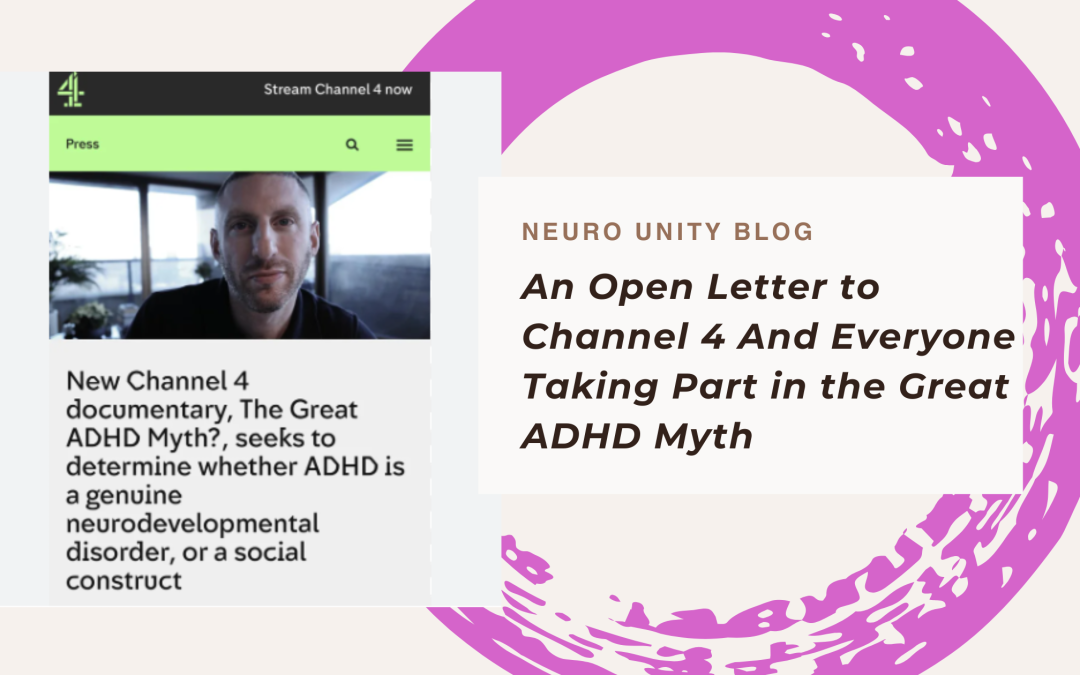
Dear Channel 4, and dear Dr Max Pemberton, Dr Iona Heath, Dr Sami Timimi and the family who agreed to take part in The Great ADHD Myth?,
My name is Lisa Ventura MBE FCIIS. I am the Founder of Neuro Unity, and I am autistic with ADHD, dyspraxia and dyscalculia. Last week I wrote a piece for Neuro Unity responding to the press release for this documentary, setting out the evidence and my own lived experience of why the “myth” framing is wrong and where it does harm. I promised myself I would not stop there. This is that follow up, addressed directly to the people who made this programme and the people who agreed to appear in it, because I think you all deserve to hear this from someone whose life it will actually affect.
To Channel 4
You are a broadcaster with a genuine public service remit, and a long history of taking on difficult subjects that other channels avoid. I respect that. But a title with a question mark stuck onto the word “myth” is not a difficult subject being handled responsibly, it is a verdict dressed up as a question. Your own spokesperson has said the documentary “does not deny the lived experience of people with ADHD traits”. If that is true, I would ask you plainly, why does the title deny it before a single frame has aired?
You cited NHS data showing a 200 percent rise in referrals between 2020 and 2025 to justify the film’s premise. That same NHS data, and the NICE guidance your own health correspondents would recognise, treats ADHD as a genuine clinical condition requiring specialist assessment, not a modern invention. I am asking you, even now, before this airs, to look again at how you are framing it. Add context. Let organisations like mine, and the people who will be affected by every headline this generates, have a genuine right of reply within the programme itself, not only in press statements issued after the backlash has already started.
To Dr Max Pemberton
You said your hope is that viewers “come away with permission to ask better questions about what modern life is doing to all of us”. I do not disagree that modern life deserves scrutiny. But permission to ask questions is not the same as a title that has already answered one. You are a psychiatrist. You know better than most that behind every one of those referral statistics is a person, often a child, who has spent years being told they are lazy, difficult or “too much” before anyone took them seriously enough to refer them. I would ask you to consider what happens to that person when the programme they eventually watch, trying to understand themselves, tells them their diagnosis might not be real at all.
To Dr Iona Heath And Dr Sami Timimi
I read your quotes in the press release more than once. “It is certainly not a medical condition as far as I’m concerned” and “we’ve replaced corporal punishment with giving [children] a pill” are strong lines, and I am sure they will get the reaction Channel 4 is hoping for. But I would ask you both, as senior clinicians whose opinions carry real weight, to think about the fifteen-year-old who is watching, who has just been diagnosed, who is already unsure whether to trust it. Your seniority does not make your view the only evidence based one. The World Federation of ADHD’s 2021 International Consensus Statement, agreed by eighty scientists across twenty-seven countries, exists precisely to set out the weight of evidence against claims like these. I would ask that this evidence be given equal space and equal weight in this programme.
To The Family Who Agreed To Take Part
I do not know you, and I am not going to pretend I understand your situation better than you do. Every family makes the choices that are right for them, and I respect that this was yours to make. What I would ask is only this, that you go into this experience with your eyes open to how it may be used. A documentary edit is not a neutral record of what happened to your son over a few weeks, it is a story shaped to fit a title that was decided before filming began. I hope, whatever the outcome for your family, that it is treated with more care than the title of this programme has been.
To All of You
I am not asking anyone here to pretend ADHD does not deserve scrutiny, that waiting lists do not need fixing, or that every diagnosis is always right first time. I am asking you to make the distinction, clearly and publicly, between asking whether our systems are good enough and asking whether people like me are real. Those are not the same question and conflating them causes harm that lasts far longer than a single broadcast.
I would welcome the chance to discuss this further with anyone involved in the programme before it airs.
Lisa Ventura MBE FCIIS
Founder, Neuro Unity
#OpenlyNeurodivergent
This letter follows my earlier piece, The Great ADHD Myth? Not From Where I Am Sitting, published on Neuro Unity.
Sources
- New Channel 4 Documentary, The Great ADHD Myth?, Seeks To Determine Whether ADHD Is A Genuine Neurodevelopmental Disorder, Or A Social Construct – Channel 4 Press
- Channel 4 Slammed As Fans Fume New ADHD Documentary Sends ‘Dangerous’ Message – Mirror, via AOL
- Attention Deficit Hyperactivity Disorder: Diagnosis And Management (NG87) – NICE
- The World Federation Of ADHD International Consensus Statement: 208 Evidence Based Conclusions About The Disorder – Neuroscience & Biobehavioral Reviews, ScienceDirect